EVIDENCE THAT STAYS WITH THE CLAIM
Build nonfiction readers can follow and authors can verify.
Keep sources, notes, claims, quotations, verification status, and references connected to the chapters that use them.
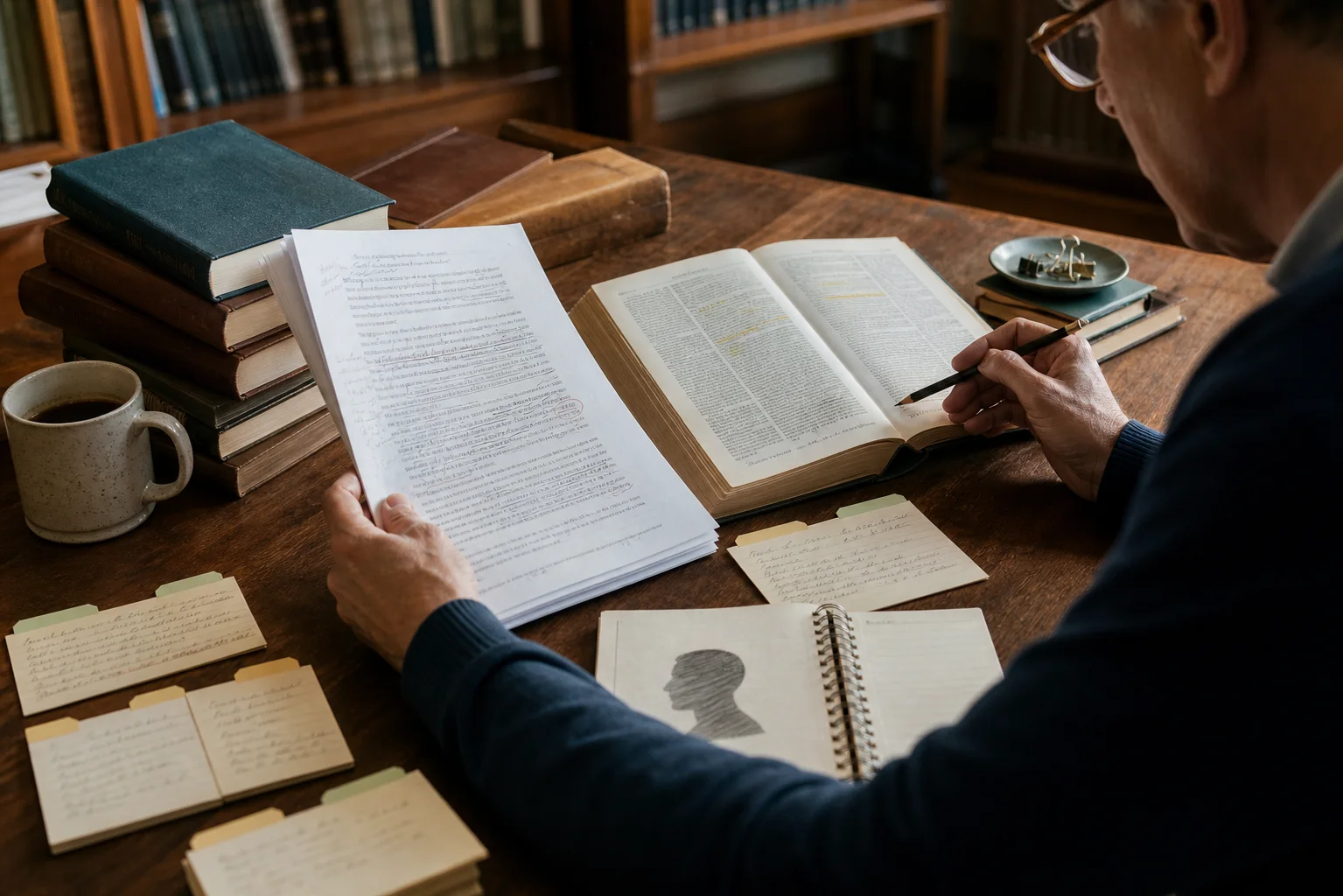
WHY IT MATTERS
The familiar workflow leaves too much for the author to remember.
A bibliography at the end cannot reveal which source supports a sentence, whether a claim changed during editing, or which note still needs verification.
More attention for the book. Less repair work around it.
Separate verified sources from open research
Build references as the manuscript develops
Reduce last-minute citation reconstruction
A clear path from decision to approved result.
- 1
Capture provenance
Save where a source came from, relevant notes, and its verification status.
- 2
Link claim and evidence
Attach research references to the manuscript passage where they are used.
- 3
Review before approval
Identify unsupported claims, missing citations, and open questions while there is still time to resolve them.

Fact-checking a nonfiction manuscript
Start with the claim, then find a source that supports that exact claim. Check the author, publication date, context and relevant passage. A reliable source can still be misquoted or used to support something it never said. Keep uncertainty visible rather than asking AI to fill a gap with a plausible answer.
BookSemantic lets you connect research notes and references to the chapters that use them. Record what you have verified and what remains an open question. After revising a sentence, check the source again: changing a number, scope or comparison may also change the evidence you need.
From research notes to a traceable bibliography
Capture enough publication detail to find a source later. Keep quotation wording distinct from your paraphrase, and note the page or location when available. Choose a citation style appropriate to the work, then review references for missing details and consistency before preparing the edition.
Manuscript analysis can help surface a passage that needs attention, but author verification remains essential. Health, legal, financial and technical claims may require specialist review. Do not present an AI-generated reference as a source you have read. A useful evidence trail makes checking easier; it is not a guarantee that every statement is true.
Keep the reason for a citation with the source
To organize book sources and citations, record more than a link. Note the claim the source supports, the relevant passage and any limit on what it establishes. A study about one group or period may not support a broader statement. Keep a quotation distinct from your paraphrase so later revisions do not blur them together.
Review that connection when a sentence changes. If you make the claim stronger, wider or more precise, check the source again. BookSemantic helps keep research near the chapters that use it; the author still needs to read the evidence and decide whether it supports the final wording.
Follow a claim back to the passage that supports it
Book research organization software should make it easier to answer a skeptical reader's question: how do you know? Keep the source, the relevant passage and your interpretation distinct. A citation manager for writers is useful when it helps you return to the evidence, not simply produce a bibliography that looks complete.
Source tracking for manuscripts also needs to survive revision. If a sentence changes from some participants to most participants, the original study may no longer support it. A manuscript reference manager can keep the record close; the author still has to reread the source and judge the final claim.
Build research notes for book writing around questions as well as answers. Record what remains unverified and what would resolve it. Evidence-based nonfiction writing leaves uncertainty visible where it belongs. A confident explanation is not improved by quietly replacing a missing fact with a plausible one.
Before using a striking statistic, check what was counted and who was included. Keep those limits with the note. Later, when a sentence is shortened for readability, you can see whether the edit accidentally removed a qualification the reader still needs.
Use research assistance without inventing certainty
An AI research assistant for authors can help organize questions or propose a clearer explanation of material you have checked. Treat any suggested source as something to locate and read. Do not present an AI-generated title or quotation as evidence merely because it resembles a scholarly reference.
If you are evaluating fact-checking software for authors, inspect the evidence trail rather than a reassuring label. Does the cited material support this exact statement, in this context, with these limitations? BookSemantic connects sources and verification decisions to the manuscript; it does not automatically certify every claim or replace qualified subject review.
A nonfiction book citation tool should retain enough publication detail to find the material again. An AI citation generator for books cannot supply missing provenance reliably from a vague description. Check author names, dates, locations and quotation wording, then review the references after the prose is settled. Citation formatting and factual support are related tasks, but one cannot stand in for the other.
WHY THIS APPROACH
Grounded in published guidance and research.
These sources explain the underlying authoring, preservation, accessibility, or AI-quality problem. BookSemantic’s feature claims describe the product experience; the sources do not endorse BookSemantic.