THE WHOLE BOOK STAYS IN VIEW
Give every chapter the memory of the book behind it.
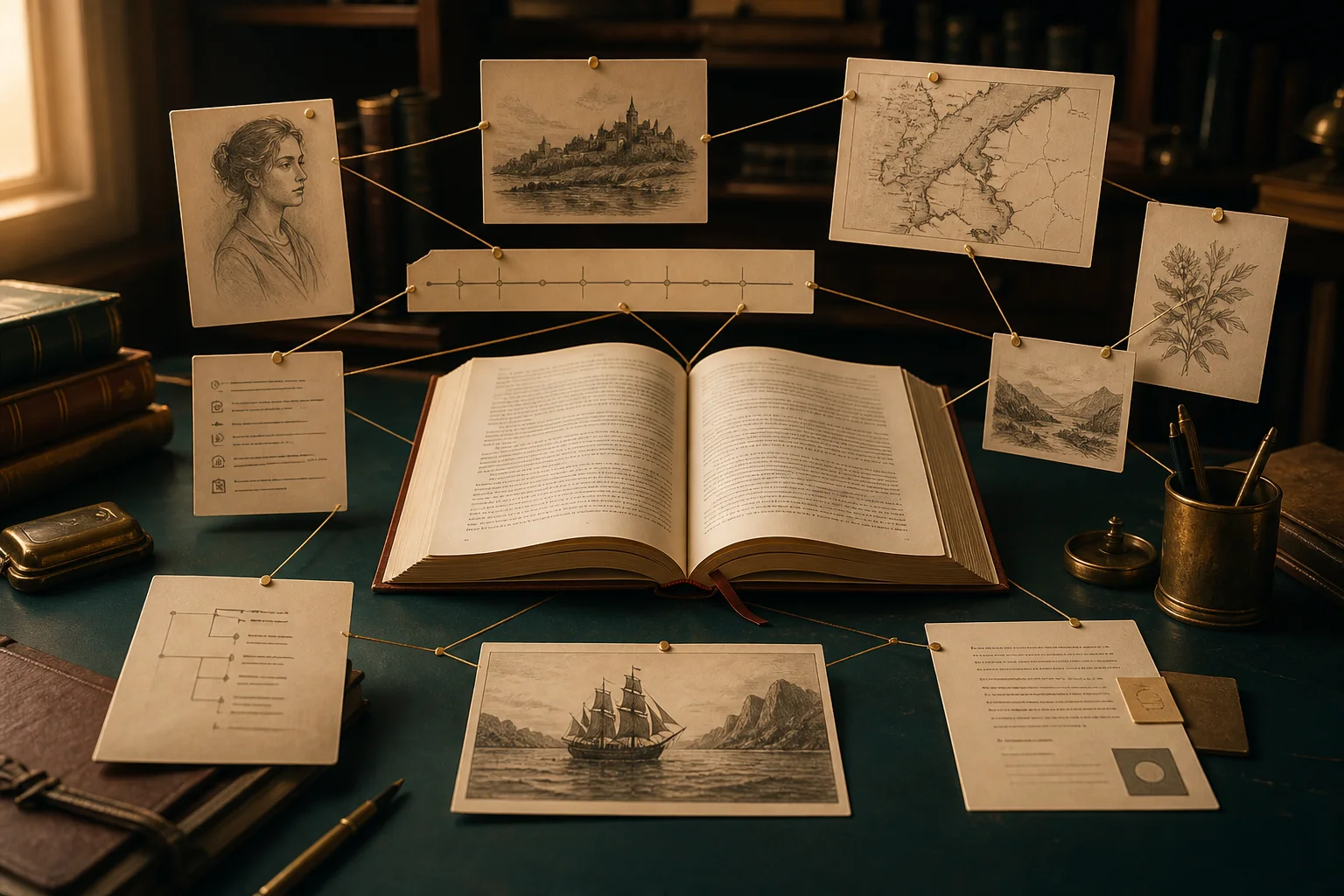
Keep characters, places, promises, themes, research, images, and chapter goals connected as your manuscript grows.
WHY IT MATTERS
The familiar workflow leaves too much for the author to remember.
A strong paragraph can still weaken a book when it contradicts an earlier fact, repeats an argument, forgets a promise, or advances the wrong character arc. Long manuscripts make those failures harder to notice and more expensive to repair.
More attention for the book. Less repair work around it.
Find continuity risks before they spread
Carry approved decisions into later stages
Keep a human-readable record of what is true
A clear path from decision to approved result.
- 1
Define what matters
Capture the premise, reader promise, structure, cast, evidence, voice, and visual direction in plain language.
- 2
Connect it to the manuscript
Mark the chapter, scene, claim, or image where each decision becomes relevant.
- 3
Review with context
See the right facts and open questions while making the next creative decision.

What is a story bible, and what belongs in it?
A story bible is a reference for the facts a book asks readers to believe. Start with the cast, places, world rules, important objects and events. Add relationships, unresolved questions and the promises the story must eventually address. For nonfiction, the equivalent reference includes key terms, claims, sources and the reader's learning goals.
BookSemantic connects these records to the writing process. You can build a story bible while planning or review facts extracted from an existing manuscript. Treat suggested facts as candidates until you approve them. A character's belief is not always the truth of the story world, and a source's claim is not automatically a verified fact.
Use book context without repeating the whole manuscript
Imagine revising chapter twelve after changing an early discovery. Check who knows the fact, which later scenes depend on it and whether the chapter's purpose still holds. Approved chapter summaries and relevant book records help you carry that context forward. You can use the same reference when writing manually; AI assistance is optional.
Book-level memory supports continuity checking, but it does not replace a full read-through. Review pivotal scenes, repeated arguments and the ending against your original promise. Intentional changes should be recorded, not mistaken for errors. Clear decisions make a large book easier to understand and a sequel easier to begin.
Record the facts that change what can happen next
A worldbuilding database for writers is most useful when its records affect the book. Note the rule that limits travel, the obligation that shapes a choice or the discovery that changes a relationship. Distinguish an established fact from a rumor, an interpretation or something you have not decided yet.
As a connected novel plotting database, BookSemantic helps keep those decisions near the chapters where they matter. Review the current state before continuing a scene. A character may have changed since the original profile, and a rule may have consequences the outline has not yet addressed.
Remember the change that matters to the next chapter
AI book writing with memory is useful when the remembered material affects what comes next. A character who has learned a secret should not behave as if the discovery never happened. Novel writing software with memory needs more than a cast list: it needs the consequences of the chapters the author has approved.
Book knowledge base software gives those decisions a place to live. Record what is established, what remains uncertain and which chapter changes the current state. Story bible software is not valuable because it stores the most background; it is valuable when you can find the right detail at the moment you need it.
AI writing, character memory and reader knowledge must also remain distinct. A person in the story may be mistaken about an event the reader has already seen. Keep that difference intentional. An AI story continuity checker can raise a concern, but the author decides whether it is a contradiction or part of the design.
A useful continuity note describes the change, not only the event. After an argument, which person has lost trust, and what will that affect? Carry that state into the next relevant scene rather than repeating the entire argument as background.
Use a compact reference without losing the larger work
Long-form AI writing software has to work within a finite context window. AI manuscript context tracking should favor the current chapter's purpose and relevant approved developments rather than repeat every note. BookSemantic uses reviewed chapter progression and continuity records; those records need inspection because an inaccurate summary can carry the wrong assumption forward.
To track details across a novel, include changes in relationships, possessions, locations and unfinished promises. Suppose a key is handed to another character. The next scene needs to know who has it, not simply what the key looks like. The same principle applies to a nonfiction term that has already been explained.
Use an AI novel consistency tool as support for a careful read, not a guarantee of perfect recall. Review and save the chapter's prose, approve its continuity record and decide when to continue. For a very long manuscript, those smaller decisions are more meaningful than a claim that a large target word count proves comprehension or literary quality.
WHY THIS APPROACH
Grounded in published guidance and research.
These sources explain the underlying authoring, preservation, accessibility, or AI-quality problem. BookSemantic’s feature claims describe the product experience; the sources do not endorse BookSemantic.